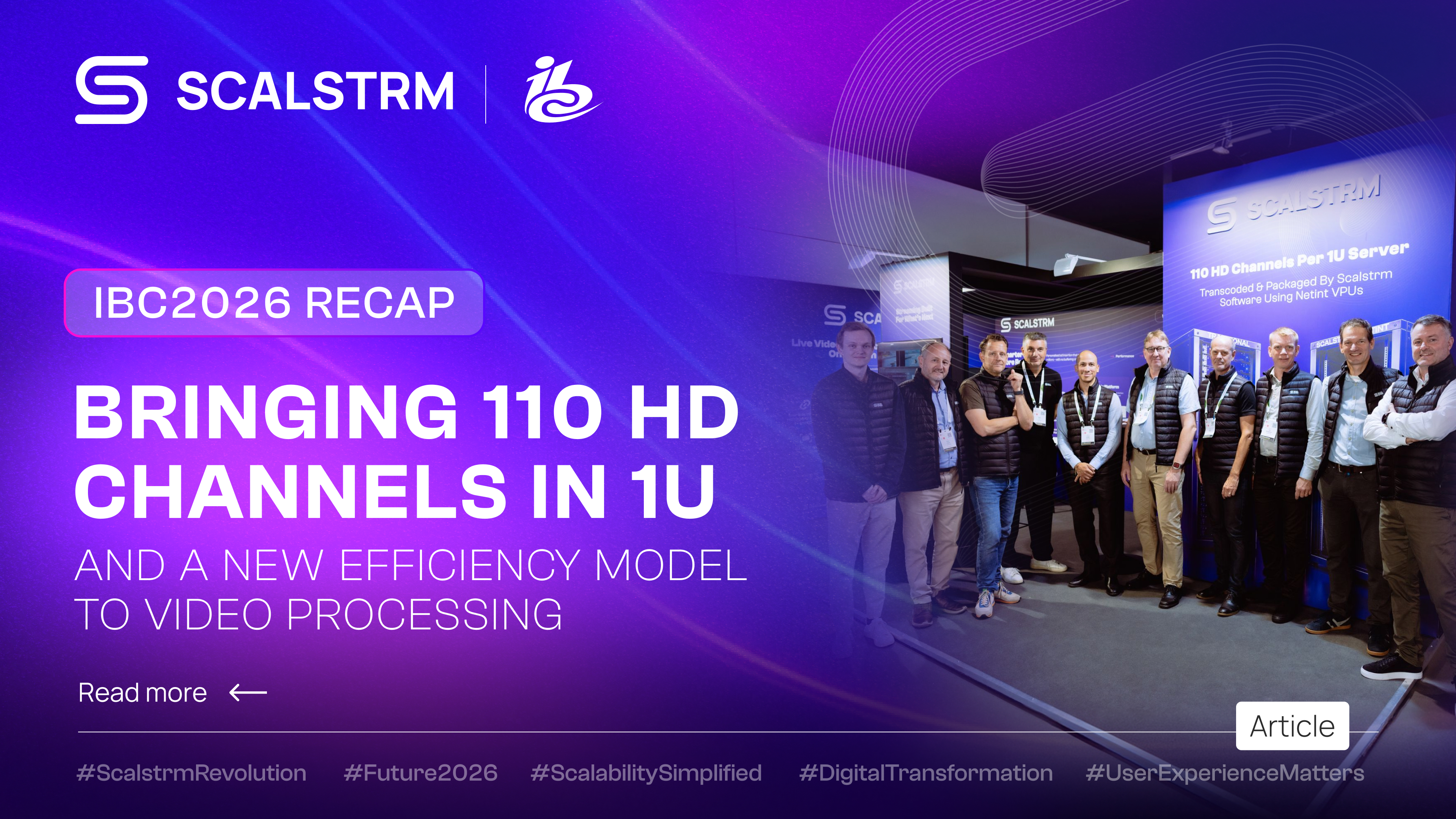
IBC2026 has closed at RAI Amsterdam, bringing four days of conversations around the technologies reshaping the media and broadcast industry.
This year’s show welcomed over 40,000 attendees from 170 countries and more than 1,300 exhibitors, with 256 companies exhibiting at IBC for the first time, a 36% increase on last year.
For Scalstrm, it meant four busy days in Hall 5, with a steady stream of operators, engineers, technology teams and commercial decision-makers coming to our booth to talk about one increasingly important question: how much more can broadcasters and service providers do with the infrastructure they already have?
We arrived with a number that gave that conversation a starting point: 110 broadcast-grade HD channels transcoded and packaged on a single 1U server, using Scalstrm software running on NETINT video processing units. The number attracted attention. The conversations behind it were more important.
Four Days of Real Conversations
A trade show stand can make it tempting to reduce a technology discussion to a headline specification. The conversations at IBC quickly moved beyond that.
Visitors wanted to understand how the density was achieved, how the platform behaves under load, what the implications are for power and rack space, and what those savings mean when they are applied across a real deployment.
That meant bringing the right people into the conversation. Scalstrm founders Patrik Alm and Ola Bengtsson were joined throughout the week by Jon Haley, Dominique Vosters, Pontus Eklöf and Simon Clarke. With the technical and commercial teams together, conversations could move naturally from architecture and performance to deployment, operating costs and business cases.
That depth was one of the most valuable parts of the week.
Why We Talk About Rack Units
Video processing density is often discussed in terms of channels per server. For infrastructure teams, however, the more useful question is what those channels require in the rack.
Rack space has a direct relationship with power, cooling, colocation costs and the physical capacity available for future deployments. That is why Scalstrm frames its density figures in terms of what can be achieved within a 1U footprint.
It also invites the right questions. What resolution and profile are the channels running at? What happens at peak load rather than average utilisation? How does the system respond when a service fails? And is the figure based on a controlled measurement or a production environment?
Those are the questions that turn a headline number into something an operator can actually use for capacity planning.
The Technology Behind the Number
The same video processing units appear across many stands at IBC each year. What separates the results is what runs on them.
Scalstrm’s platform is built on a microservice-native architecture without legacy code, allowing individual processing functions to scale independently rather than forcing an entire system to be over-provisioned around a single bottleneck. The result is a platform designed around the capabilities of purpose-built video processing hardware, while retaining the flexibility of software-defined processing.
“The gains do not exist in the hardware alone and they do not exist in the software alone. They exist where the two were designed for each other. There is no legacy code in our platform to work around, and that is why the figure holds in production rather than only under favourable conditions.”
– Ola Bengtsson, Founder and CTO, Scalstrm
That approach also gives Scalstrm a foundation for adopting new silicon, codecs and processing capabilities without having to carry the limitations of a legacy architecture forward.
Looking Beyond the 50% TCO Figure
A 50% reduction in total cost of ownership is a useful headline. The more interesting question is where that saving actually comes from. Fewer servers reduce hardware requirements. A smaller infrastructure footprint reduces power consumption and associated cooling requirements. Fewer machines can also reduce the operational overhead involved in monitoring, maintaining, patching and replacing infrastructure.
The impact becomes more significant at scale. For operators managing large channel volumes, even relatively small differences in infrastructure requirements can accumulate across hardware procurement, facilities, energy and ongoing operations.
That was a recurring theme in Amsterdam. Rather than simply asking whether the technology is more efficient, visitors wanted to understand how the numbers translate into their own environments and business models.
“The question that follows a 50% figure is always some version of, where is the catch. It is a fair question and it deserves a specific answer rather than a reassurance. The best conversations we had in Amsterdam were with teams who had already run their own numbers and wanted to find out exactly where the difference sits.”
– Patrik Alm, Founder and CEO, Scalstrm
Already Running in Production
This is not technology waiting for its first production deployment. Scalstrm is already running at scale with Tier One operators across the Nordics, including NRK, TV4, Viaplay, Telia, Telenor, Elisa and RiksTV, supporting more than 21 million daily active viewers.
The platform delivers up to 50% lower total cost of ownership, 80% less power consumption and 80% less rack space, with deployment options across on-premise, cloud and hybrid environments. For organisations operating across Europe, that flexibility also supports deployment requirements around cloud sovereignty and infrastructure location.
The 110-channel figure brought to IBC2026 was therefore not a theoretical benchmark. It was a way of showing what the combination of Scalstrm’s software architecture and NETINT’s video processing hardware can deliver in production.
What IBC2026 Said About the Industry
Efficiency was not a conversation confined to the video processing stands at IBC2026.
AI, emerging technologies and new approaches to media production and distribution featured heavily across the exhibition and conference programme. At the same time, every new workload ultimately has to run somewhere, using finite amounts of power, compute and physical infrastructure. That makes infrastructure efficiency increasingly relevant to the wider transformation taking place across the industry.
For operators, reducing the resources required to deliver existing services can create room for new ones. The rack capacity, power and operational headroom recovered from today’s workloads can become capacity for tomorrow’s applications.
Continuing the Conversation
Four days at IBC gave Scalstrm the opportunity to put its technology in front of the people who have to make infrastructure decisions every day.
Thank you to everyone who stopped by Stand 5.G56, challenged the numbers, asked the difficult questions and stayed for the longer conversations.
For those who could not make it to Hall 5, the conversation does not need to end with IBC. The Scalstrm team is available to discuss the numbers in the context of your own infrastructure, workloads and deployment requirements.